

FAQ 1 – What are all the loom parts called?
FAQ 2 – What do I need to make my own loom?
FAQ 3 – What yarns are suitable for backstrap weaving?
FAQ 4 – How do I wind a warp for backstrap weaving?
FAQ 5 – What is a good knot to use to tie off on the warping board?
FAQ 6 – Where can I tie up my loom in my home?
FAQ 7 – How do I make continuous string heddles?
FAQ 8 – How should I sit when I am weaving?
FAQ 9 – How do I open the sheds on a narrow warp?
FAQ 10 – How do I open the sheds on wide and/or sticky warps?
FAQ 11 – How do I stop my shed rod from moving around?
FAQ 12 – How do I create a third selvedge?
FAQ 13 – How do I keep my edges straight? (warp faced weaving)
FAQ 14 – What do I do when my edge warps get slack?
FAQ 15 – How do I roll up my work as it progresses?
FAQ 16 – Can I weave a piece without a fringe? ie a four-selvedge piece?
FAQ 18 – How do I go about weaving wider pieces? (Information is embedded in this blog post.)
FAQ 19 – How can I memorize a pattern and stop using a chart?
FAQ 20 – What is a coil rod and how is it used?
FAQ 21 – How do I finish a band with fringe?
And I will be adding to this list from time to time….
Stay tuned!











 Backstrap Weaving
How do you determin the warp color when using a three color warp?
By: Elizabeth on November 21, 2010
at 5:44 pm
I am not sure I understand what you are asking, Elizabeth. Perhaps you could email me.
By: lavernewaddington on November 21, 2010
at 11:58 pm
Laverne, I did find the answer to my last question- now I am so trying to figure out how you roll the weaving up using second sticks next to the original warp sticks; every time I try to roll the extra warp up on a stick next to the tieup end everything just unrolls and makes a really big mess. Help!!
By: Elizabeth on November 23, 2010
at 3:31 pm
Elizabeth, until I get that FAQ topic answered with photos, the very best way to see this is in my video on WeaveZine’s Youtube channel. Here is the link…. you may have to copy and paste it.
The part about rolling up the warp starts at around minute 4. I hope this helps.
By: lavernewaddington on November 23, 2010
at 7:39 pm
Laverne, I am having issues with the shed and heddle sticks wanting to flop over whenever I am trying to weave- is there something I am not doing right? Do I not have enough pull on the warp strings?
I am so glad you pointed me to the video- must not have watched enough of it the first few times; thank you so much.
By: Elizabeth on November 26, 2010
at 4:33 pm
Elizabeth, how do you have the far end of your loom tied up? Do you have it attached to a single point like a door knob or hook? That kind of tie up would definitely cause things to be flopping around annoyingly. Try lashing the entire end bar to something. That is by far the most stable set up.
By: lavernewaddington on November 26, 2010
at 4:39 pm
This is getting to be a real challange; for some reason- have been weaving on the floor loom for way to many years and I am so determied to get this right!
By: Elizabeth on November 26, 2010
at 4:34 pm
Hi Laverne, I actually have it tie off on the ends of a 12″ stick- both ends- there are only about 14 ends of warp on the loom ends- I am going to try a longer stick on the tie-up end and see how that fairs; for some reason the weft is not beating dow properly- the tie-up end has been slipping- but a longer stick should also help with that problem also. I will let you know who everything progresses. Thank you so much for all your help. Liz
By: Elizabeth on November 26, 2010
at 8:36 pm
Hello Laverne, Are we going to have a weavealong? Haven’t seen anymore mention of one; or I cannot find the right website for it?! I really need to get a better handle on these things.
Thank you so much, Elizabeth
By: Elizabeth on January 8, 2011
at 5:29 pm
The weave along is on Ravelry. I will email you with the link.
By: lavernewaddington on January 8, 2011
at 5:34 pm
Hi Laverne,
I hope these questions are not too dumb ! I am first time weaver 1. how do i calculate how much warp i need for any project? 2. Your videos are great but when you take off the back strap for example prior to braiding….how is that done?
Many thanks Ken
By: ken on April 12, 2011
at 1:58 pm
Hi Ken,
You need to weave samples with the yarn you have chosen for your project. You will lose length in take up and the percentage of length you use will depend on the weight of yarn you are using. For example I lost 30% of length in the backstrap project so I know that for my next project with that same yarn I will need to wind a warp that is at least 30% longer than the desired length of the finished item. There is no getting away from sampling. If you want a project to come put well you need to make a test with the yarn first. This will also tell you the kind of width you can expect to get.
When you finish weaving the backstrap just pull out the loom bars, remove the heddles and all sticks and you will be left with a woven band with warp ends at either end ending in loops. As for the braiding the ends of the backstrap, just group the unwoven warp ends and braid as you would someone’s hair. Take several warps ends and form three groups. You could make five braids across the width of the piece. Braid as far as you can. You will be left with loops in the ends through which you can pass another braided length of cord and that is what attaches the backstrap to your loom bars.
By: lavernewaddington on April 12, 2011
at 5:02 pm
Hi Laverne,
Many thanks for taking time out to reply, i appreciate it !
Ken
By: ken on April 13, 2011
at 8:59 am
Me again – Sorry if you answered this elsewhere, but I would like to know why it is called “pebble weave”. Where does it get this name?
By: Dave Holly on June 4, 2011
at 3:54 pm
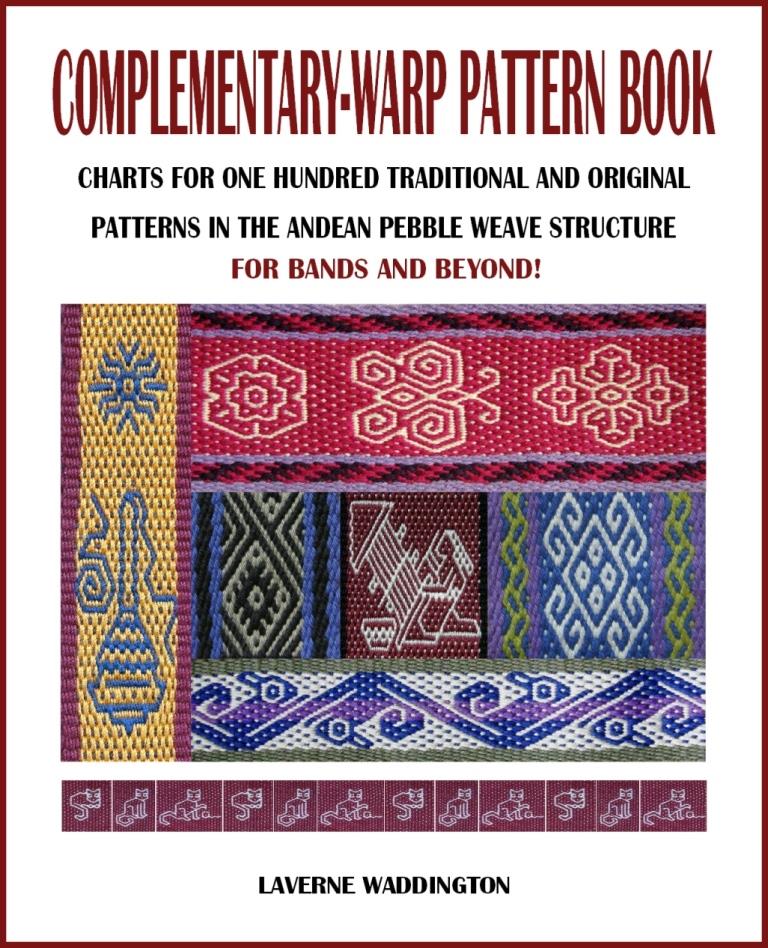
I was told by Anne Rowe that the name “pebble weave” was first used by Adele Cahlander and Marjorie Cason in their book on Bolivian weaving. The pebbles are the tiny spots that appear between the floats on the face of the fabric. The words “pebble weave” are often applied to any textile that has a spotty look but the structure to which the words were first applied is the Andean one that I describe in my book.
By: lavernewaddington on June 4, 2011
at 4:10 pm
I am having difficulties with my weft threads showing in spots while doing a two color background pebble weave.
By: Paula Hodges on September 3, 2012
at 4:54 am
Hi Paula,
The weft often shows just a little particularly along the edge of diagonals. It should just be the faintest “shadow” along the diagonal line. It tends to show more on thicker yarns and will not be noticeable at all when using very fine yarn. If it is showing a lot, you may need to shift your warps so that they are closer together or check that you have not twisted warps or made a mistake when doing the pick-up.
By: lavernewaddington on September 3, 2012
at 8:33 am
Hello Laverne, I haven’t done any backstrap weaving for years, but hope to get back to it. I plan to make a wedding band for my friends who met on a Quaker study tour in Bolivia. They have four cats and I would like to weave cat motifs into the band along with a short quote from their vows. I wonder if you know of any traditional cat designs I might be able to use? I haven’t tried Andean pebble weave yet, so this will be my first ambitious attempt.
With many thanks,
Lucy
By: Lucy on December 6, 2013
at 3:29 pm
Hi Lucy,
I haven’t seen any cat motifs in my travels but there is a feline figure on pre Columbian textiles that I have seen in books. It can be done in pebble weave. It will have to wait until I am back home so I can access the books.
By: lavernewaddington on December 12, 2013
at 10:55 am
Thank you Laverne.
I look forward to your findings. Yes any feline motif would probably be fine.
Lucy
By: Lucy on December 12, 2013
at 5:51 pm
Do you have a tutorial on cutting, sewing, finishing the ends for making cuffs?
I’m not the same Lucy as above!!!
By: Lucy D on December 28, 2015
at 5:24 am
Hi Lucy. No, I am sorry, I have not made a tutorial for that part of the process. The thing is that I make my cuffs with very fine materials, like 60/2 silk and that makes the finishing relatively easy. The fabric is so fine that I can easily fold over the ends twice and hem them without creating excessive bulk. If you were working in heavier thread, hems like that would make the whole thing quite clumsy, I think. A friend of mine recently wove a cuff using 10/2 cotton and I think that she could hem those ends nicely. You might want to put some Fray Check or similar product along the end of the band before cutting the unwoven warp ends. I have found that the Fray Check stiffens the fabric and therefore gives a nice crisp fold when you turn the fabric to hem. Be careful, though, as the Fray Check can sometimes leave a watermark.
By: lavernewaddington on December 28, 2015
at 1:46 pm
Hello Laverne,
Would you be able to do a zoom lecture, about 1 hour, to our weavers guild?
Thank you,
Joan Swift
Eugene Weavers Guild
By: Joan Swift on September 12, 2020
at 8:38 pm
Hi Joan. I emailed you but have not heard back.
By: lavernewaddington on September 15, 2020
at 1:40 pm
Laverne, I’m having a bit of trouble setting up for my first backstrap, having tried plain weave on my Ashford Inklette.
I’m just trying to calculate yardage for my first backstrap project, for each color that I have designed and “spinning” so I want to not have to spin more than I need.
Is there a post or FAQ or is it discussed in one of your pdfs that I’ve missed (or not read yet?) on how to calculate yardage?
I am trying to figure per color section on my first project of two identical fringed table place mats 12″x16″, I plan to weave in sequence, needing a yard in length on the loom I figure.
My inkle band yarn (I make) shows 24wpi, and on the inkle loom its actually double that I’m weaving, as there are 24 on both sheds = 48 threads per inch total. Do I calculate needing 48 threads per inch (x12″ would be 576!!!) This can’t be right. I’m not calulating correctly, it must be half that.
My project then would have 2 yards of each thread, for each complete warp? I suppose that is 2 yards x 24 threads PER INCH, which looped around is actually 48 per inch when set up on the loom. Is this double weaving?
I so much appreciate your helping us out; I’ve managed to collect most of what you offer on Taproot, and I’m confident I will get this, that it will become second nature, but I struggle so much with the first steps, its almost funny!
Would be great if there was a FAQ on this subject if there isn’t already a post, which I’ve searched, probably missed. I also have seen your email on the pdfs, and yet I can’t find when I need to email, so please tell me if you would prefer me to ask visible to all your readers via comments, or email .
Thank you so much!
Jen
By: Jen on July 19, 2023
at 2:54 pm
Hi Jen. First if all, let me say that I can only give general advice because I have no idea about your weaving background and the amount of experience you bring to this. Secondly, I’m assuming you are going to weave warp-faced fabric.
I feel I need to point out that if this is your first ever backstrap loom project, 12″ is way wider than what I would recommend particularly if you are using hand-spun. It’s a huge leap from the kind of width you get on an inkle loom. The thing is, you shouldn’t underestimate what’s involved with first of all learning how to use the loom. First-timers will typically have difficulty with working the heddled shed…and that’s with smooth mercerized cotton. It’s a whole other story when using hand-spun.
I recommend trying something 2 inches wide and about 24 inches long to begin with. You’ll learn what’s involved with transferring a warp from the warping stakes to your loom, the kinds of problems that will arise if you haven’t created an evenly-tensioned warp, what happens when you make a mistake on your string heddles, how your handspun behaves in string heddles on a backstrap loom, how to move your body to relax tension when necessary to help you operate the loom……and a bunch of other things….all without feeling overwhelmed by 12 inches of width and stressed because of the waste of your handspun (because maybe 12 inches is just too much to ask from a first-ever project).
The two-inch project will answer your own questions about yardage.
But if you are still wanting to go ahead and start with 12 inches width, there’s this: If I count 24 threads in an inch in a single “row” on my warp-faced cloth, I know that I need 48 ends to make an inch. If my warp is 36 inches long, I’ll need to calculate 36″ X 48 to give me the total length of yarn for one inch of woven cloth.
BUT if you want two fringed pieces 16″ long each, you’ll need a much longer warp than 36″. Your two placemats with an inch of fringe will measure 36″ (32 inches of cloth plus say, 4 inches of fringe). There’s take-up to consider as well as what I call “comfort space”. You’ll know about take-up from your inkle loom. You’ll want, especially when you are new to this, at least 10″ of space in which to be able to comfortably operate the loom. I always play safe and add 50% to my finished fabric length. That would make your warp 54″. It will be more than you need but better safe than sorry, I say.
Now, if +50% seems too much to you and you’re not keen on possibly wasting your handspun by playing it safe like this, you should first weave the 2-inch-wide sample that I recommended. Measure how much length you are able to weave before you start feeling cramped and uncomfortable and unable to smoothly operate the loom. Struggling to operate the loom to try and crank out another inch WILL affect your weaving. Compare that to the original warp length. It will also enable you to calculate take-up. And with that you can figure out how long to make your placemat warp.
By: lavernewaddington on July 19, 2023
at 4:47 pm
Laverne, I very very much appreciate your going into depth explaining things, and you are a true and great teacher!
Okay, I didn’t realize it , but perhaps I was being unreasonable with (in my thinking “only”) 12 inches width. I will try something more along the lines of 2 “, and let that be my lesson about yardage. Thank you, a good principle to double the length of intended finished item. THat said, I am not a fan of fringes, and if I had my way, there’d be no fringe but a 4 selvedge weaving, of course, that is ridiculous for a beginner to try, I realize. Your blog is so very extensive, I can only check your FAQ index, or search, but might be missing the information, so I will just ask away in the comments, so others may benefit from my questions.
I started this whole backstrap thing being completely in love with Peruvian, absorbed as much as I could from some books authored by Nilda at Cusco Center of Traditional Textiles, as well as some random books Weaving Primer, and Techniques of Guatamalan weaving) I’ve decided to stay true to your instruction, and not distract and confuse myself with other types of backstrap weaving.
Oh, and that was me a few weeks back asking on another post, how I might get balanced weaving on a backstrap loom. I have posted about all of this on my blog, which might interest you to see how I am making yarn, not really spinning, but reconstructing a commercial brand; https://jenjoycedesign.com/2023/07/17/weaving-the-colors-of-the-landscape/
By: Jen on July 19, 2023
at 6:36 pm
I’ve been using tablet cards for weaving (with my rigid heddle loom as the base); however, I want to figure out if there is a possibility of converting patterns for tablets to Andean Pebble Weaving or pick-up weaving.
By: Karen Paul on June 10, 2024
at 4:39 pm
I’ve adapted certain tablet-woven patterns to the structure that I call Andean Pebble Weave and published them in my pattern books. Figures outlined with diagonal lines are easy to transpose. I find that the figures are more elongated when woven this way. Tablet weaving gives one the ability to use many colors along the same warp path. Basic Andean Pebble Weave allows two although there are three and four-color varieties that are far more complicated.
By: lavernewaddington on June 27, 2024
at 6:38 pm